Brisbane Melbourne Hobart Launceston Devonport


Safety isn't a checklist.
It's a system.


Safety isn’t a checklist — it’s a system.
Most organisations treat safety as a step in a process.
A compliance requirement.
A final sign-off before operations
But that’s not where safety is won or lost.
Safety failures rarely come from a single fault.
They emerge in the gaps.
Between systems and disciplines.
Between design intent and real-world operation.
Between assumptions and actual use.
By the time a system reaches compliance review, many of the critical risks are already embedded.
The challenge isn't simply identifying hazards, it's understanding how systems interact.
In modern industrial environments, nothing operates in isolation. Machinery, control systems, electrical infrastructure, people, and processes are inherently connected. When they are not engineered as one integrated system, risk increases.
Safety starts at the system level
Effective safety is not added at the end of a project. It is engineered from the outset.
At Cromarty, we approach safety through three integrated pillars:
Machine Safety
Designing safer machines based on how they're actually used in operation.
Machine safety is about aligning design with real-world function, not theoretical operation.
What this includes in practice:
- Machine safety risk assessment facilitation
- Machine safety design and engineering
- Safety system installation, integration and commissioning
- Existing system compliance reviews
- Ongoing system maintenance and support
- Safety products and solutions
- Training programs delivered through Pilz
Hazardous Areas
Getting hazardous environments right before risk becomes reality
Hazardous area compliance is not just documentation.
What this includes in practice:
- Hazardous area classification and engineered design
- Installation oversight and lifecycle compliance management
- Review of existing hazardous area installations
- Hazardous area dossier development and governance
- Routine inspection, testing and maintenance programs
- Digital compliance management through the ExOnline platform
LV Arc Flash & Electrical Compliance
Understanding and controlling high-energy electrical risk before it happens.
Electrical safety requires precise modelling, engineering and ongoing control, not assumptions.
What this includes in practice:
- Arc flash studies and system modelling
- Risk assessment and remediation planning
- Switchboard compliance review and upgrades
- Integration of arc flash controls into electrical system design
It doesn’t stop at commissioning
A system might meet compliance today.
But what happens after modifications?
Under operational pressure increases
After years of continuous use?
Industrial systems are designed to operate for decades, not months. Safety must therefore extend across the full lifecycle, not just installation.
Without ongoing review, validation and support, system integrity degrades and risk gradually returns.

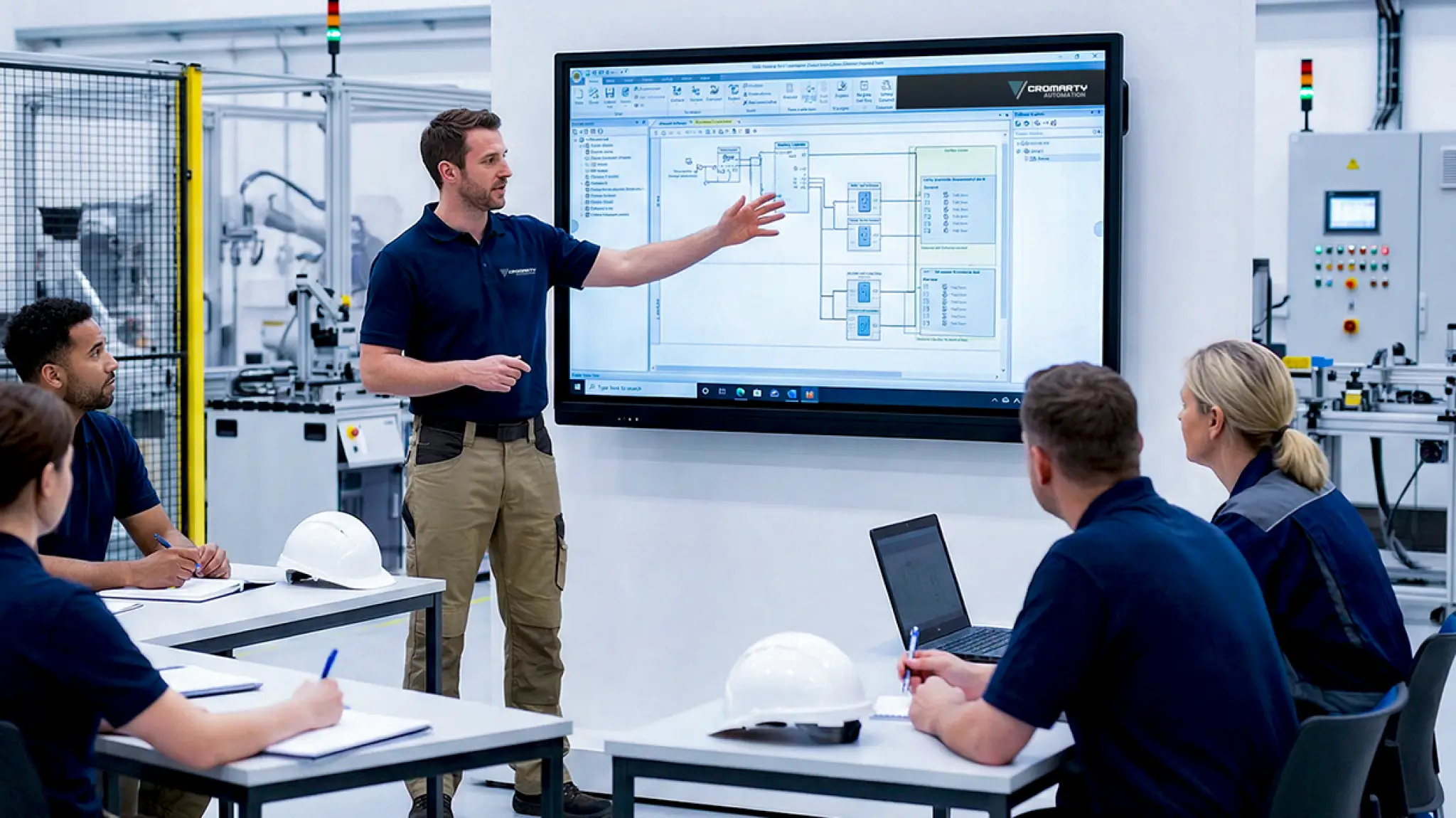
Even the best systems rely on people
Automation improves consistency, reliability and baseline safety performance but it does not remove human interaction.
Training, competency and understanding remain critical.
Because systems don't fail in controlled environments.
They fail in live operation.
A different approach to safety
At Cromarty, safety is not treated as a standalone service or compliance activity.
It’s engineered into every stage of a system, from concept and design through to operation and lifecycle management.
Because safety isn’t something you add at the end.
It’s something you design from the beginning.
